
This article was originally published in The Examiner on October 19, 2017.
By Eleanor Skelton
Staff Writer
The day after the city of Beaumont lost water, 18-wheelers loaded full of water began arriving at Beaumont’s First Baptist Church.
This was part of the relief stage of the church’s efforts.
Getting through a hurricane or flood involves several stages: rescue, relief, and recovery, Pastor Christopher Moody said a few days after Harvey passed over Southeast Texas. Trucks loaded with cleaning supplies, clothing, formula and diapers came over the next several weeks from as far away as Brooklyn, New York.
Volunteers gave out supplies to long lines of cars while the church served as a distribution center, staff said.
Volunteer “mud out” crews started clearing out flooded homes in Bevil Oaks and Pinewood.
Some of the volunteers were church members, but others were from Louisiana and Georgia.
Relief efforts are now focused on treating damaged homes for mold and bacteria and giving out sheetrock to rebuild, especially for those without flood insurance, Moody said.
Lee Roy Hervey, the church’s facilities manager, does many of the treatments.
“[ShockWave is] an inhibitor that prevents mold and mildew from spreading, basically stops it in its tracks,” Hervey said. “Bacteria and all that.”
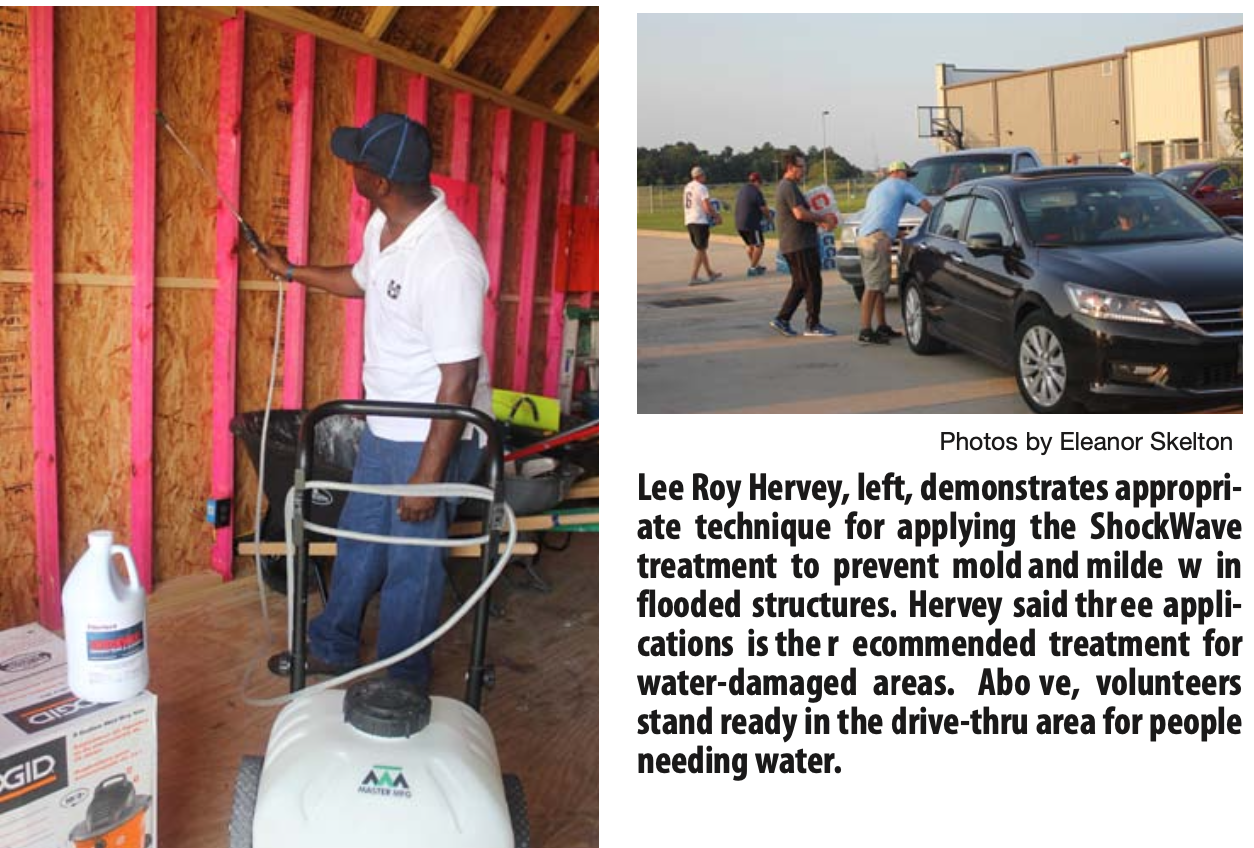
After the homeowner or mud-out crews remove the damaged sheetrock and insulation, Hervey and others spray every surface in the home three times.
“That’s each room three times and the flooring three times,” he said. “If it’s tile floors, we only spray it once.”
The home has to be vacuumed and swept and all cabinets and furniture taken outside. Tile may or may not be removed — it’s up to the homeowner.
“Some people think they can move their furniture to the center of the room, and you can’t do that because you have to treat the floors,” children’s pastor Melissa Johnson
said. “If you don’t treat the floors, you’re still going to have mold issues.”
The ShockWave treatment is free to the homeowner, but they have to hire a professional to do a moisture test and certify that the home is safe to rebuild, Hervey said.
“Because you don’t want to seal the sheetrock and it have moisture in it, because then you’ll start collecting mold again,” he said. “If they ever resell their home, they have to have proof that they had this done.”
“When I spray a stud, I spray each side up at the top and come back on this side of the stud all the way, and so I did every stud in the house three times,” Hervey said, demonstrating with his equipment.
“[The process] could take anywhere from two and a half to four hours,” Johnson said.
The ShockWave treatment is provided at no charge to the community. Anyone can ask to have their home treated by going to the church office or signing up on the website, fbcbeaumont.org.
Assessment teams check homes on the church’s list to make sure the house is ready, Hervey and Johnson said.
Volunteers helped in about 70 homes total and treated 20 houses with ShockWave so far, Executive Pastor Mark Adams said.
Now that many homes have been gutted and treated, the church has also given out donated sheetrock for those rebuilding.
 Eleanor Skelton