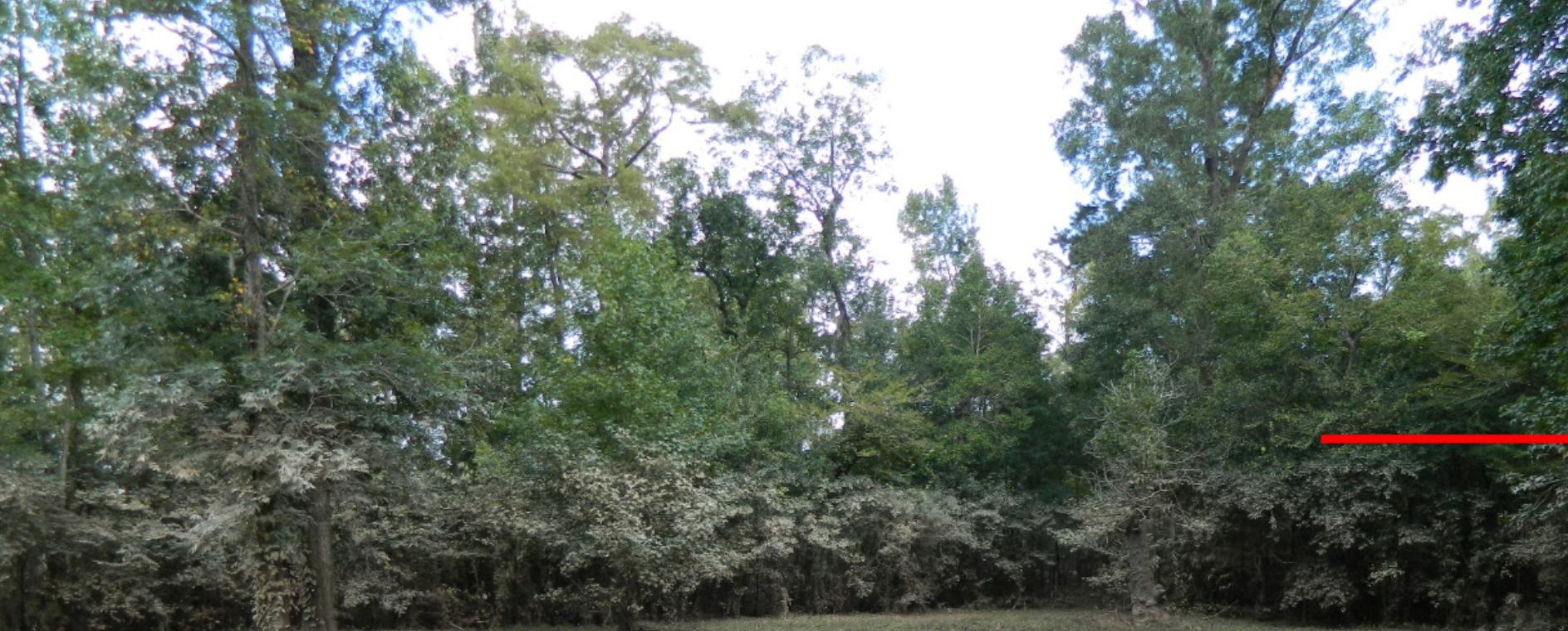
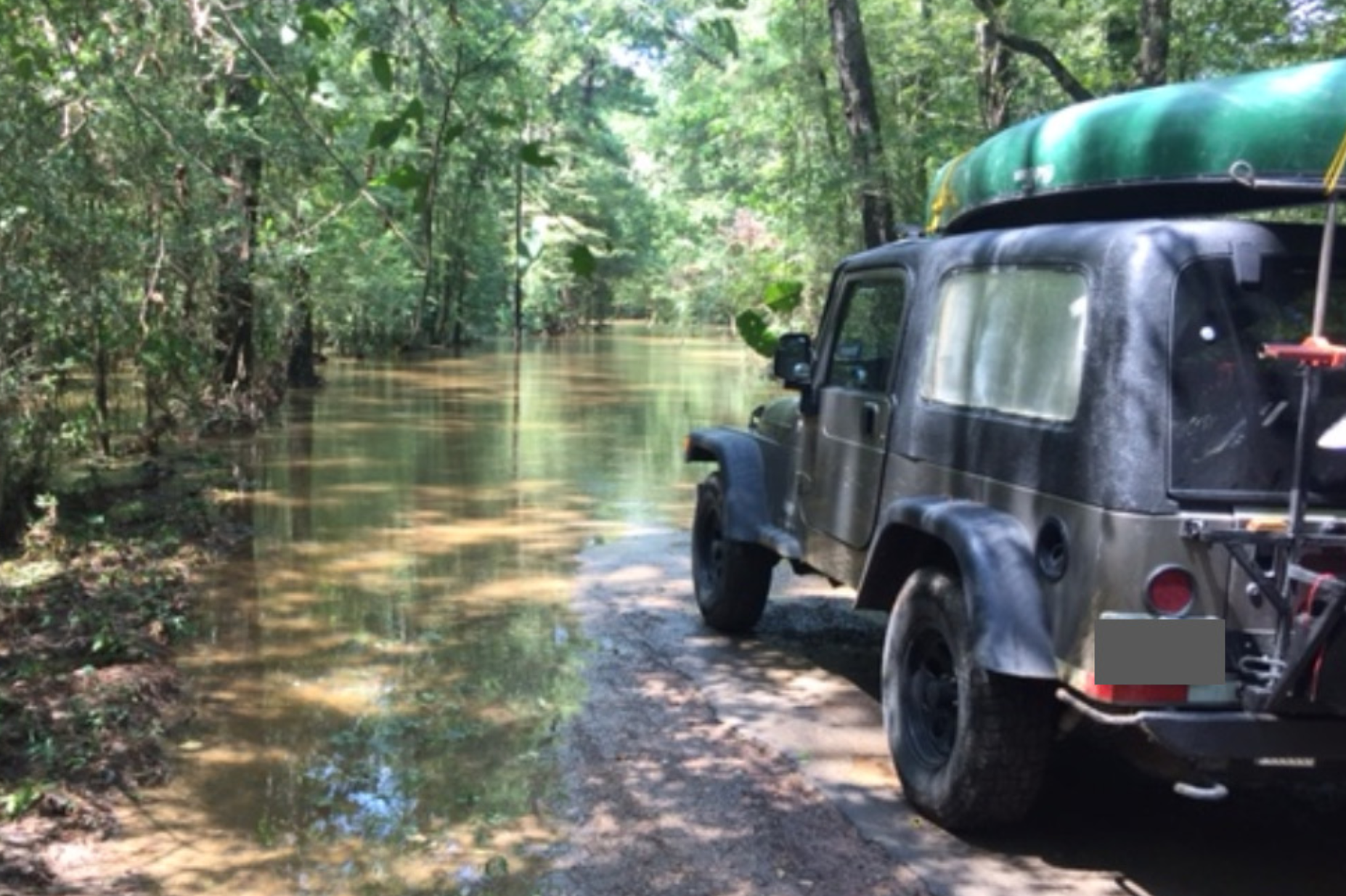
Discolored foliage, marked below the red line above, shows the high water mark in the Day-Use Area. Water flows across the road, below, and through the Turkey Creek Trailhead days after Hurricane Harvey dumped rain on the Big Thicket watershed. | Photos: Courtesy of the Big Thicket National Forest
This article was originally published in The Examiner on Dec. 14, 2017.
By Eleanor Skelton
Staff Writer
Harvey caused flooding throughout Texas that Southeast Texans had never seen before, not only for neighborhoods and homes, but also for the diverse wildlife that lives in the Big Thicket.
Deer drowned, snakes were displaced, and alligators came up in unexpected places, park staff said.
But despite Harvey’s “unprecedented” flooding in late August, about 22 of the Big Thicket National Preserve’s 40 miles of trails were accessible by Sept. 18, National Park Service spokesperson Jason Ginder said in a news release, only a few weeks after the tropical storm.
Park officials had closed the Big Thicket at noon on Aug. 25 in preparation for the storm, but reopened with limited access to the trails Sept. 5.
“We are glad to see visitors coming back to the park,” Ginder said on Dec. 5, adding that the park is starting to return to normal visitation numbers.
Every spring, the Big Thicket releases data about the economic benefits the park brings to Southeast Texas.
In 2016, 192,809 visitors to the Big Thicket National Preserve spent $12,347,900 in communities near the park, Ginder said in a release April 20, supporting 172 jobs in the Southeast Texas area with a cumulative benefit to the local economy of $15,909,400.
Park staff doesn’t have a current estimate on how Harvey may have changed 2017’s numbers.
“We are definitely going to see a decline in our annual visitation due to the two weeks we had to be closed during the Hurricane Harvey recovery,” Ginder said.
Recovery from Harvey was a hot topic at the annual Big Thicket Day on Saturday, Oct. 14.
No park buildings were damaged, although floodwaters threatened the preserve’s infrastructure along the Neches River, Turkey Creek, Village Creek, Cypress Creek and
the Pine Island Bayou, Park Superintendent Wayne Prokopetz explained to a crowd of families with young children gathered at the visitors center.
The Big Thicket staff had warning that Harvey was coming since park service staff get briefings on tropical storms when the tropical depressions leave Africa, he explained.
Park staff cleaned out pit toilets before the flood, attempting to prevent contributing to diseases and waste leaking into surrounding neighborhoods.
All park employees were safe during the storm, although two employees lost their houses in the flood, Prokopetz said.
National Park Service staff assisted Southeast Texas first responders during the rescue stage, helping get flood victims with air boats.
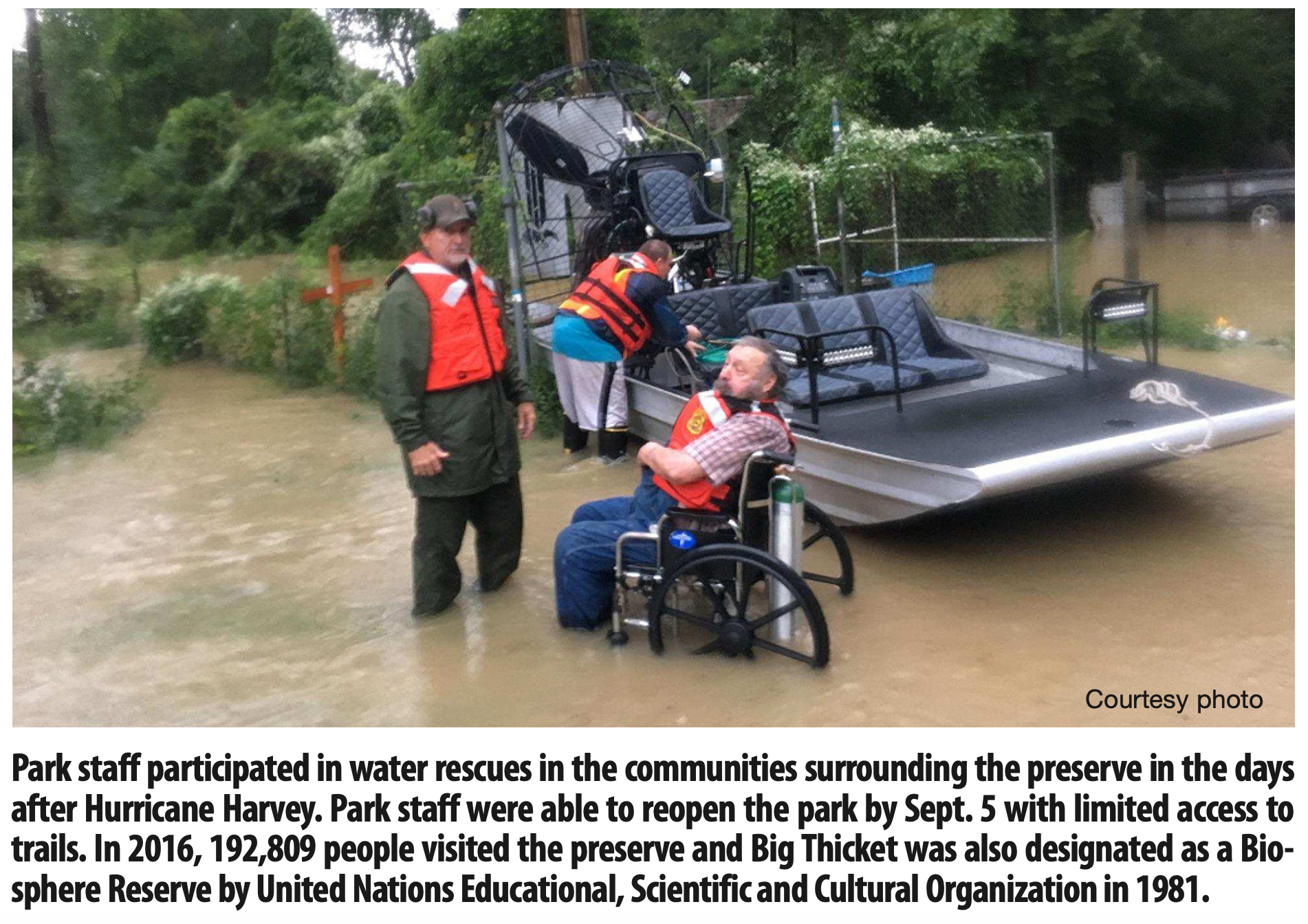
Park staff participated in water rescues in the communities surrounding the preserve in the days after Hurricane Harvey. Park staff were able to reopen the park by Sept. 5 with limited access to trails. In 2016, 192,809 people visited the preserve and Big Thicket was also designated as a Biosphere Reserve by United Nations Educational, Scientific and Cultural Organization in 1981. | Photo: Courtesy of Big Thicket National Forest
The Buna and Beaumont radio repeaters were part of the damaged equipment and were inoperable, he said.
Superintendent Prokopetz gave an overview of Harvey’s damage to the Big Thicket’s roads and trails and the National Park Service’s recovery plans.
The trails and bridges throughout the park were most impacted, he said.
The park’s total estimate of damages is currently $200,000.
At one point, Prokopetz said the park was 60 percent underwater.
Harvey’s flooding caused most of the damage. Prokopetz said park staff didn’t have issues with falling trees this time, unlike during Hurricanes Rita and Ike, which were primarily windstorms.
In his presentation, Prokopetz showed the audience how high the floodwaters came in one of the day-use areas during the peak of the storm.
Some unpaved roadways in the preserve washed out and needed to be repaired, Ginder said.
The Big Thicket is often described in travel guides as the most dense forest region in Texas, and one of the most biodiverse areas in the world outside of the tropics. The wildlife is still recovering, park staff said.
“Extreme water levels throughout Southeast Texas [displaced] many wild animals,” Ginder said in a news release, cautioning nearby residents.
Despite the destruction, the park was able to remove 12 bags of trash and more than 1,000 pounds of debris in four hours on Sept. 30, which is National Public Lands Day, Prokopetz said.

Senior director and dean of the Dallas Zoo’s Wild Earth Academy Benjamin Jones gave the keynote speech: “Growing the Next Generation of Conservation Champions.”
Jones is a Southeast Texas native who said he’s still adjusting to Dallas’ flat prairies and misses the East Texas Pineywoods.
He showed a video of Wild Earth students planting trees in the Big Thicket and talked about the importance of sharing your love of nature with the next generation while they’re still young.
During the festivities, Big Thicket National Heritage Trust president Ellen Buchanan presented several awards to staff and volunteers, including the R.E. Jackson conservation award to Adrian Van Dellen, president of the Neches River Watershed Sentinels and the Chair of the Texas Black Bear Alliance.
Buchanan explained that Van Dellen’s dream is reintroducing black bears to East Texas, including in the Big Thicket.
“We would love to walk in the woods and maybe see a bear one day,” he said.
Van Dellen has also written a paddling guide for those interested in kayaking the Neches River.
Since Big Thicket Day, park staff continued working on recovery.
All roads and trails are now open except for portions of the Turkey Creek Trail, Ginder told The Examiner on Dec. 5.
The park replaced culverts underneath the two damaged roads in the Lance Rosier Unit during the month of November, Ginder said.
“Our radio system is now fully up and running,” he said.
He explained their intermountain regional office in Denver helped replace the damaged electronics about two weeks ago.
The park also plans to raise one of the buildings housing the system, putting it on stilts for future floods, Ginder said, but their plans are contingent on this year’s federal budget passing Congress.
 Eleanor Skelton