This article was originally published in The Examiner on Dec. 28, 2017.
By Eleanor Skelton
Staff Writer
Harvey devastated Southeast Texas neighborhoods over four months ago, but many families are spending the holidays displaced by the flood damage.
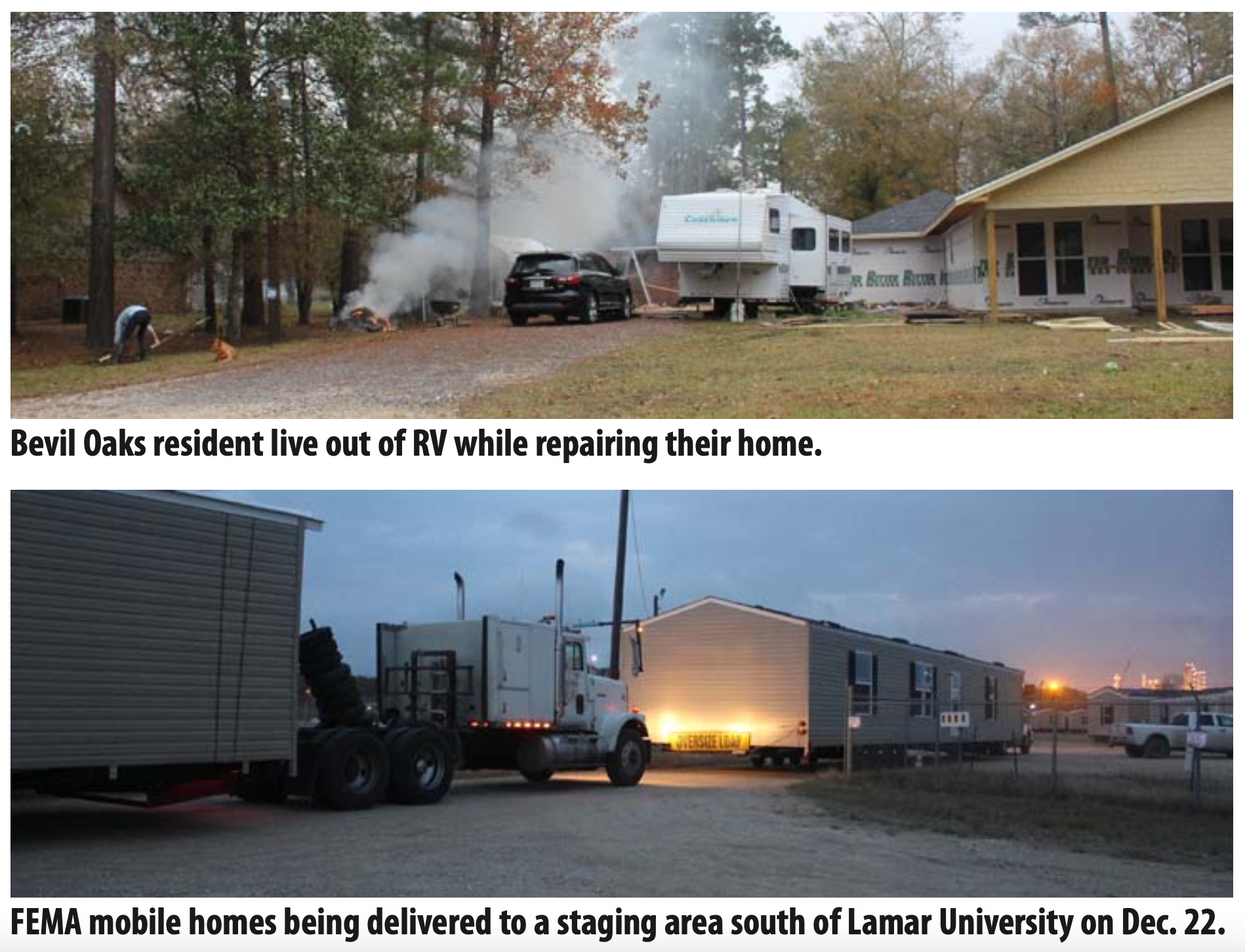
The Jefferson County Commissioners Court discussed implementing a blanket permitting system Dec. 4 to speed up delivery of direct housing units — more commonly referred to as “FEMA trailers.” Multiple FEMA mobile homes were being delivered the week ending Dec. 22 to a staging area on Martin Luther King Parkway just south of Lamar University.
During the December meeting, Jefferson County Environmental Control Director Ronda Conlin stressed the importance of making sure the county has a paper trail identifying the location of the units, especially once the mandated 18-month leasing term expires.
As of Dec. 4, Conlin reported that 263 renovation permits had been issued and 65 more were waiting on more information to be in compliance with FEMA.
Conlin said that she believes her department has been processing the applications quickly, but some applications are missing information.
“We haven’t been holding them up, we’ve just been processing them,” she said. “We had a bunch that were sent without the homeowner’s name. That’s important to us because we’re using those to make sure that they have been turning in their renovation permits so that we can comply with the FEMA laws.”
“I worry just with our communication with FEMA so far,” Conlin said in the Dec. 4 meeting. “We are having trailers that we dropped without ever having permits or even anybody knew that it was there.”
Another concern is septic systems, Conlin said, explaining that some flooded rural areas use only septic, which is a concern when waste from both a house and a mobile home are connected to the same system.
“That could conflict with other Texas laws on what you can use for the amount of water for those systems,” she said. “I don’t think we should do the blanket,” Conlin argued. “I think we’re processing quickly enough that it’s not warranted, and it keeps us more on the information side so we can check up on these and make sure that when they are removed, they actually are removed.”
But with Christmas approaching, commissioners were concerned.
“These people don’t need to wait any longer,” Commissioner Brent Weaver said. “I can’t blame them that they’d get upset.”
Weaver encouraged environmental control to continue expediting the process.
Several housing solutions are being used to help Harvey victims, explained FEMA spokesperson Ken Higginbotham. Direct leasing enables the federal government to lease property that would not generally be available, he said, and limited home repair is the program for houses with moderate damages.
Manufactured housing units are like travel trailers and can help with housing needs for up to 18 months, but applicants must have been pre-disaster homeowners whose residents had a FEMA inspection to qualify, Higginbotham said.
More than 800 families in Jefferson County had been housed as of Dec. 18, FEMA spokesperson Tiana Suber said. About 40,000 more were in pre-placement interviews waiting to hear from the Texas General Land Office to see if they’d been approved for a trailer.
More than 1,800 work orders were in the system for more trailers, Suber said Dec. 18.
But close to 8,000 affected by Harvey were still in need of housing as of Dec. 18, she said. Roughly 100 families were being housed each week, Suber said, and she anticipated that about 1,000 more would be housed before the end of the year.
Several residents in Bevil Oaks and Port Arthur said they were looking toward the holidays with a different viewpoint post-Harvey.
Don Etheridge, who lives in the 7900 block of Sweetgum Road, told The Examiner he has been living out of an RV he bought after Harvey for the last three months. His daughter, who was renting a trailer behind Vautrot’s Cajun restaurant, also flooded and is living with them.
“[FEMA] gave us some money, it’s not near enough to fix the house,” he said, adding that he is waiting on an SBA loan application. “We had between 5 and a half to 6
feet [of water] in the house.”
This is the third house in Bevil Oaks that Etheridge has lost, he said.
He was raised at the corner of Sweetgum Road and Blackgum Street since he was 10 years old, he said, but the house flooded in 1994, floating off the stilts.
After that, they lived in a double-wide trailer on the property, which burned down due to an electrical short after Hurricane Ike.
He and his wife moved out of the Southeast Texas area after the fire, he said, but came
back to be close to family.
“It’s probably going to be three strikes and we’re out of here,” he said. “If the SBA don’t come through with something decent, we’re probably just going to have to walk away from it.”
Etheridge said he planned to spend Christmas with his wife’s sister in Wildwood. His wife liked to decorate for the holidays, but that’s not an option this year.
“There ain’t room for a Christmas tree in an RV,” he said. “You drive through here after dark — it’s like a ghost town. There’s no lights in the houses or anything. They’re bulldozing houses every day out here.”
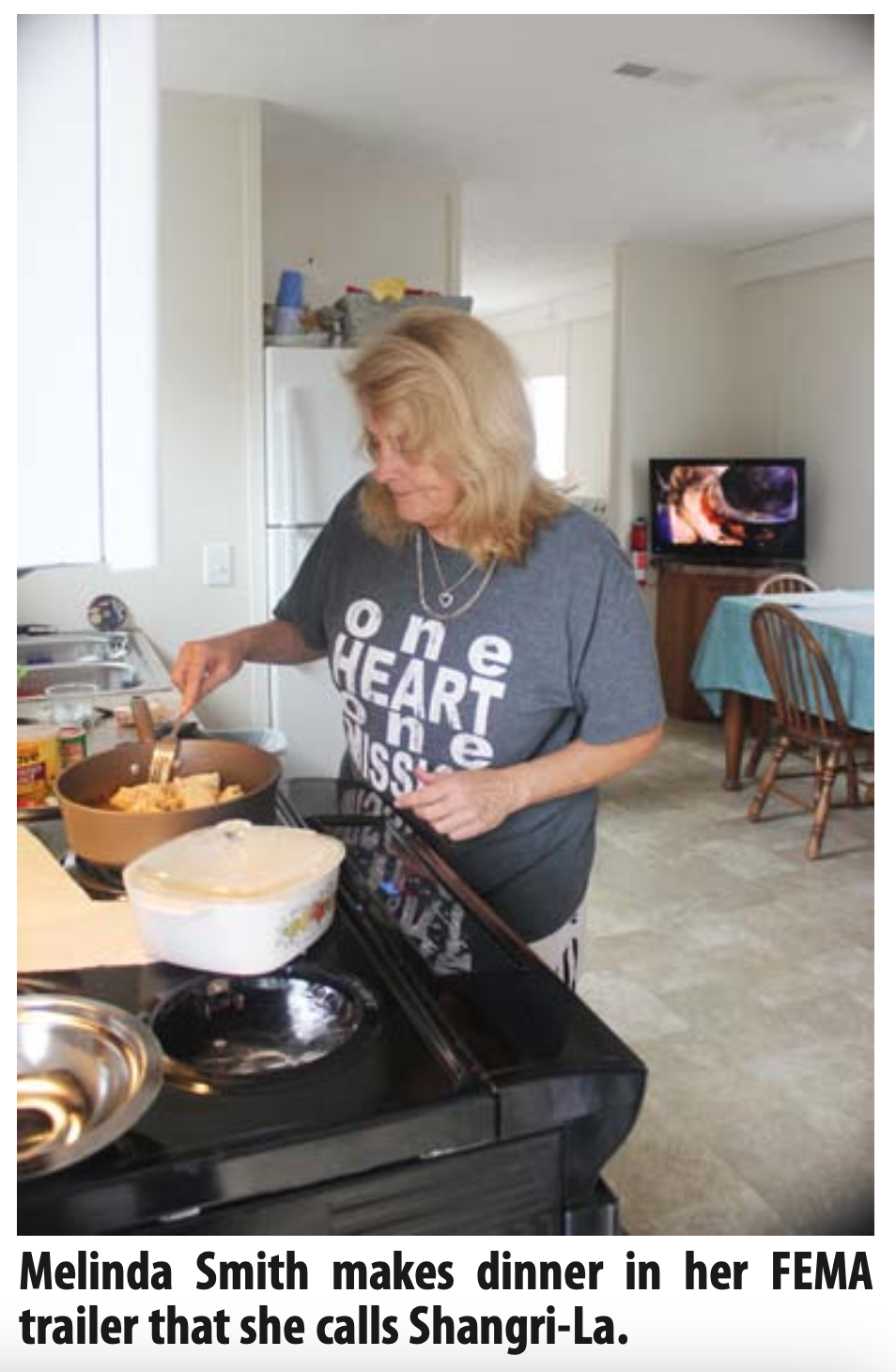
Melinda Smith, another Bevil Oaks resident, calls her FEMA trailer Shangri La or the Taj Mahal.
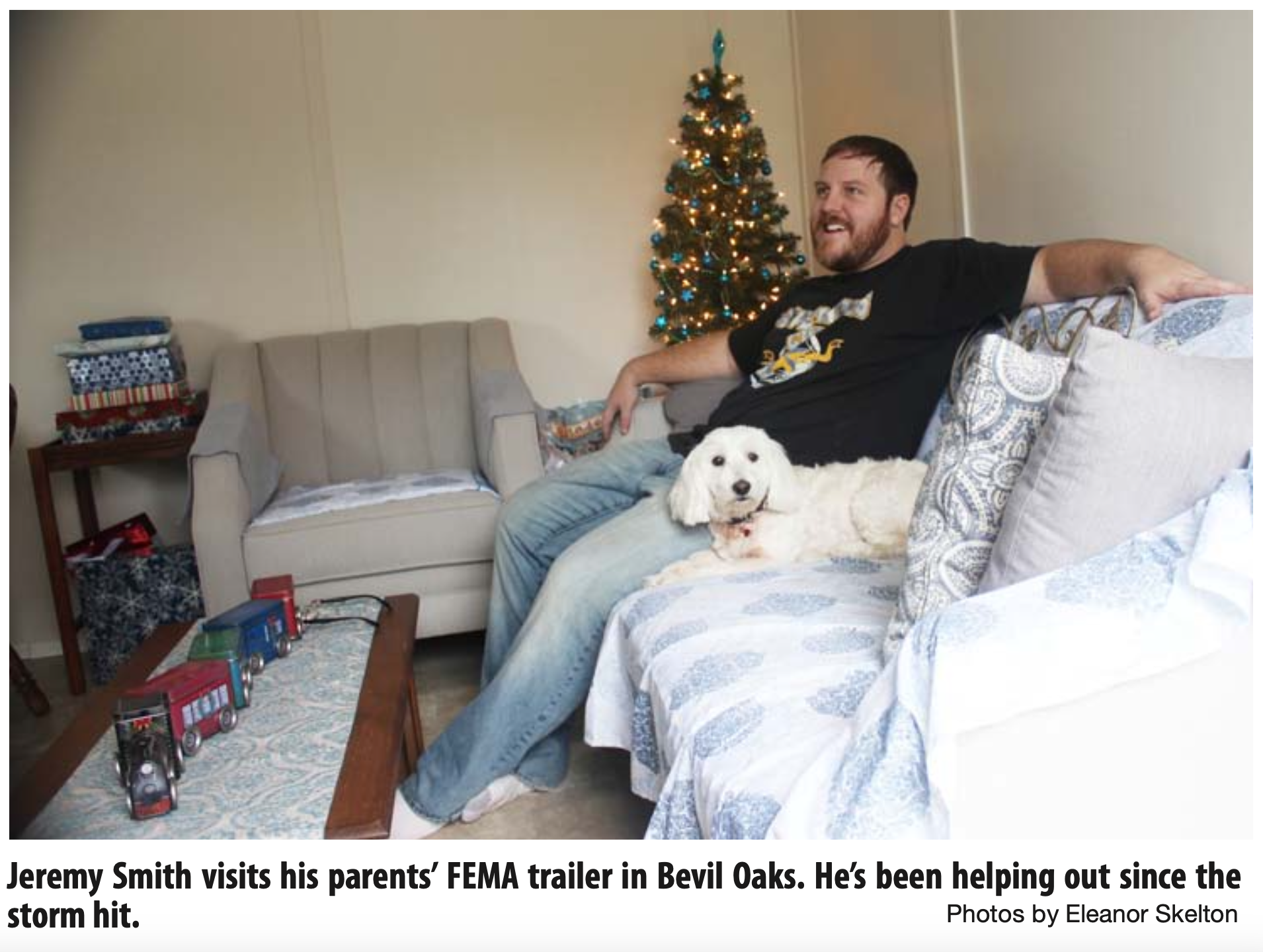
Before she received the manufactured housing unit from FEMA, she had been living with her mom and her brother. Her son Jonathan and his girlfriend, who lived in another house, were also displaced and moved into her other son Jeremy’s small apartment in Beaumont.
Jeremy said he lost childhood mementos in his parents’ house.
“I don’t know what we did or said to qualify for this,” she said, referring to the trailer. “I appreciate anything and everything — but this is huge.”
She and her husband, who recently retired from coaching at West Brook High School, had flood insurance for their home, but it didn’t pay for temporary housing. She said she had multiple conversations with FEMA before her trailer was delivered around Nov. 7. All furnishings are also provided through the program, she said.
Kenisha Newton rented a house on 19th Street in Port Arthur before Tropical Storm Harvey, she said.
The floodwaters were about knee deep in her house, Newton said, adding that she was also laid off from her job after the storm.
She and her son have been living in hotel rooms paid for by FEMA since August, first at the Deluxe Inn and now at the Baymont Inn.
“It’s sad. Normally we have a Christmas tree; we’re [now] in one motel room. We’re not doing our traditional things,” she said. “It doesn’t feel like Christmas, [but] we’re thankful that we are alive.”
Her landlord was supposed to finish repairs as of Dec. 29 when she spoke with The Examiner on Dec. 22, but she didn’t expect to be home by then.
Lilia Reyes has been homeless for four months, she explained through an interpreter, but she said she used to live on Eighth Street in Port Arthur. She’s now living with her daughter-in-law Megan Brodeur.
She said that she feels stressed, sad and depressed going into the holiday season.
Reyes said she also had no flood insurance. She said she had not yet received a FEMA trailer.
 Eleanor Skelton