
This article was originally published in The Examiner on Feb. 8, 2018.
By Eleanor Skelton
Staff Writer
Michael Wolf was born a month before World War II ended into a Jewish family
that narrowly escaped Berlin just a few years before.
“I’ve never told this story before,” he said, “[I’ve] never been asked.”
He said his mother told parts of the story and he shared some of it with friends, but not publicly.
Temple Emanuel hosted a film screening last October of Persona Non Grata, about the life of Chiune Sugihara, a Japanese diplomat posted in Lithuania known for issuing visas to Jewish refugees against orders.
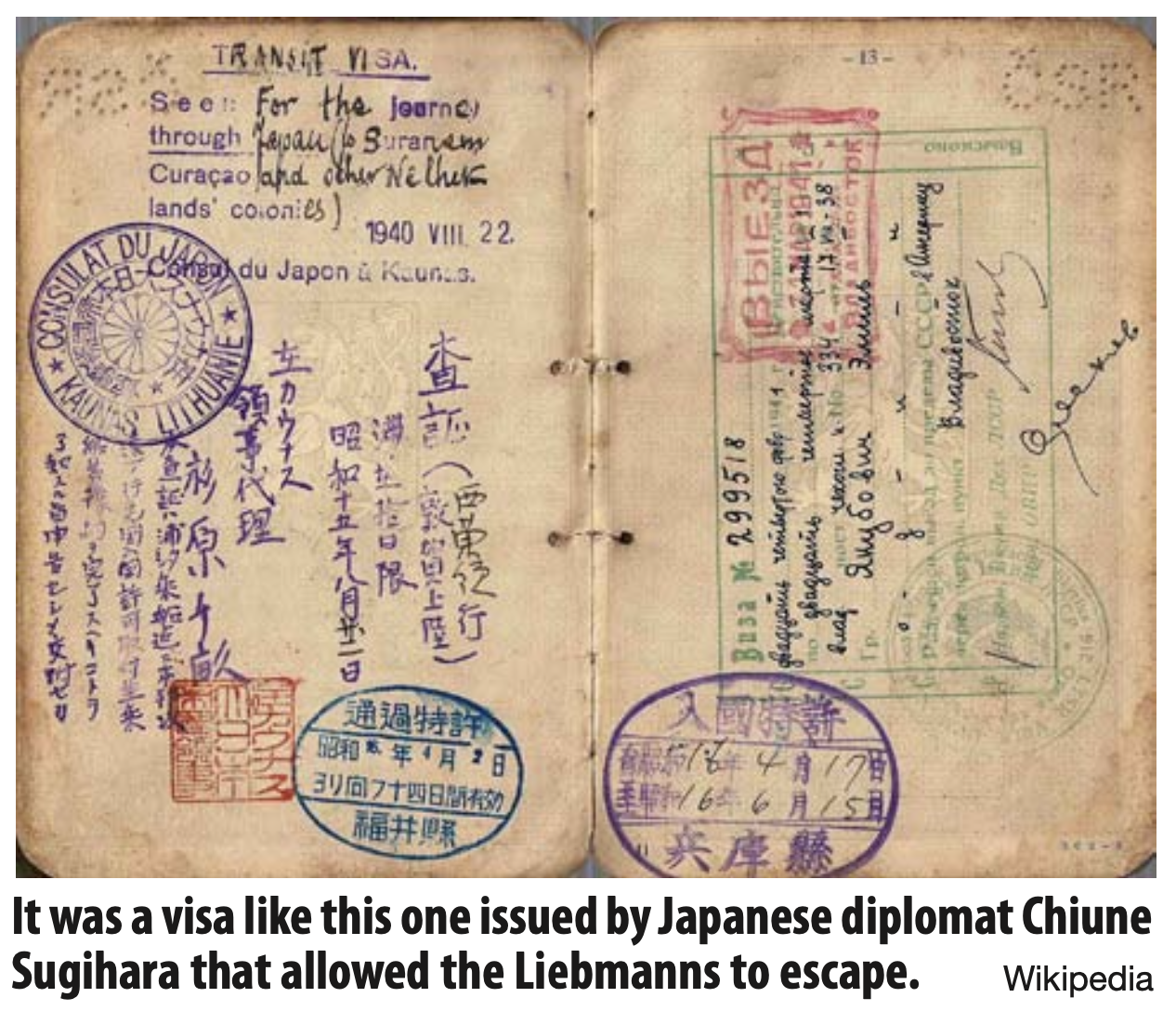
Sugihara issued over 2,000 transit visas in July and August 1940, according to the
United States Holocaust Memorial Museum.
Wolf’s grandparents, Erich and Henny Liebmann, along with his uncle, Herbert, were some of the refugees given visas, Wolf said. Some 40,000 people are estimated to have descended from the people Sugihara helped, NBC News reported in February 2016.
The Liebmanns left Berlin in September 1940 by way of the Soviet Union and Shanghai, then ending up in Ecuador, where they stayed until the war was over because the United States would not allow the ship’s passengers to enter, Wolf said.
Their escape was enabled by Sugihara continuing to issue visas at a Berlin train station after he and his family had to leave Lithuania, he said his family members told him.
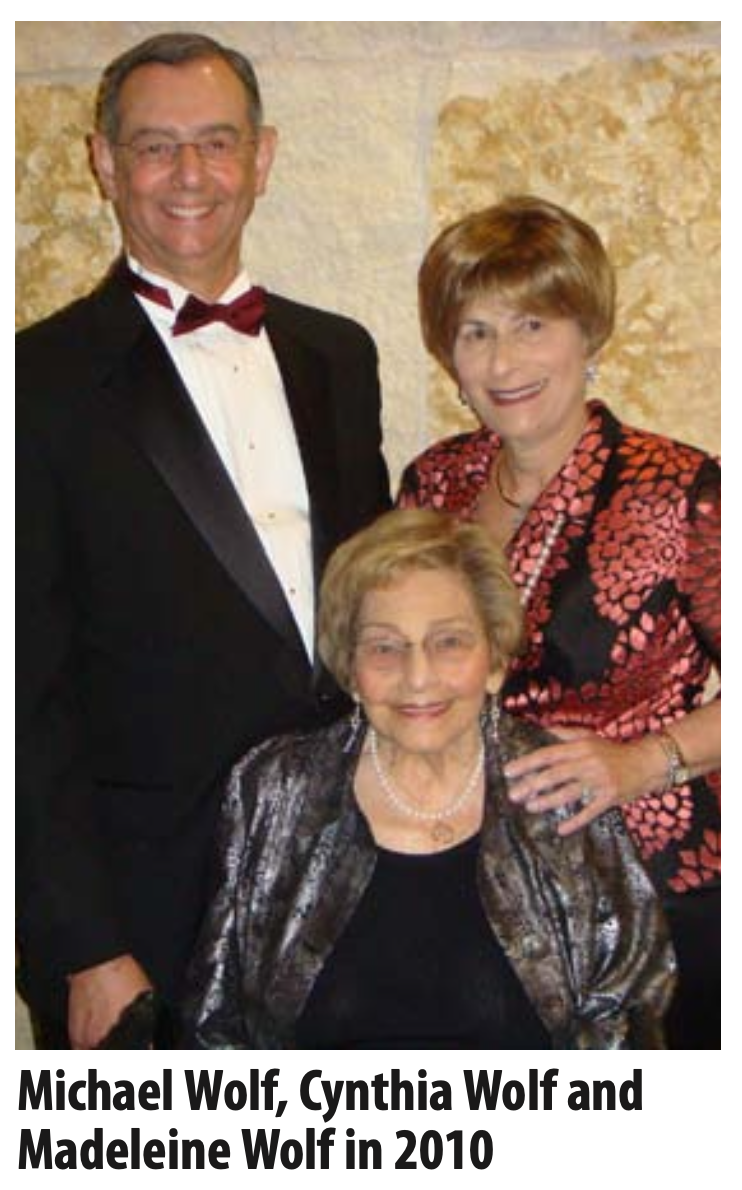
Michael Wolf’s mother, Madeleine, was smuggled out of Berlin in March 1940, just
a few month prior, he said.
Madeleine was only 14 years old when her father secured passage on a kinder-transport train from Berlin to Italy, where she boarded a ship bound for the United
States with the help of the Hebrew Immigrant Aid Society, Wolf said, explaining that she was sponsored by her mother’s sister Edith and her husband Walter Marcus who were already living in Harrisburg, Pennsylvania.
“She saw the handwriting on the wall,” Wolf said, explaining that Edith had already immigrated to the United States in the late ’30s.
“My mother did not look like a typical Jewish young lady — she was blonde and blue-eyed,” he said. His Uncle Herbert, who was 18 at the time, was too old to leave with his sister.
For a year and a half before their escape, the family hid in the homes of two non-Jewish families in the same neighborhood in Berlin, Wolf said.
“My mother unfortunately had to go into hiding with my grandfather and my grandmother and her brother,” Wolf said. “They separated. The men went to one home and the women went to another home.”
He explained they could see each other in a nearby park, but the family had to be nonchalant to avoid being found out.
“My mother would meet my grandfather and sit across the park from each other so they could see one another, but couldn’t go near each other, before they escaped,” he said. “That’s how they survived that year being all separated.”
“But then finally, my grandfather arranged for her escape, she left as a little girl by herself with nothing.”
While living with her aunt and uncle in the U.S., his mother met his father, while he was stationed in Williamsport, Pennsylvania. Wolf’s father was originally from South Texas, near Harlingen and Brownsville.
“They got married when she turned 18,” he said. “Her uncle wouldn’t let her get married until she graduated high school, [but once] she turned 18, [she] got married to my dad and he brought her back to Texas.”
Wolf said he was 3 months old when the young family came back to Texas.
Wolf said he never met his uncle since Herbert unfortunately passed away in South America while they were waiting to immigrate to the U.S.
Herbert would have been 23 at the time, Wolf said.
Wolf is now a financial professional at Wolf Bunt & Associates and chairman of the Beaumont A&M Club’s Classroom Teacher Awards, as well as a past president of Temple Emanuel.
And it’s all thanks to Sugihara.
“Sugihara had to choose between his career and doing the right thing,” said Cynthia Wolf, Michael’s wife.
Sugihara’s diplomatic career was basically finished after he defied orders during the war, but he’s now considered a hero in Japan, according to NBC News.
“The most important thing that [Madeleine] could do was to defy Hitler and have a family,” Cynthia said. “She survived to bring forth future generations.”
Wolf’s mother passed away in 2012, but he said the experience never left her.
“It was a haunting thing her entire life,” he said, explaining that she still feared people coming to harm her or reading her mail when she was in her 80s and sought counseling at that time.
Wolf said that watching the film about Sugihara “filled in some of the gaps” for him.
 Eleanor Skelton