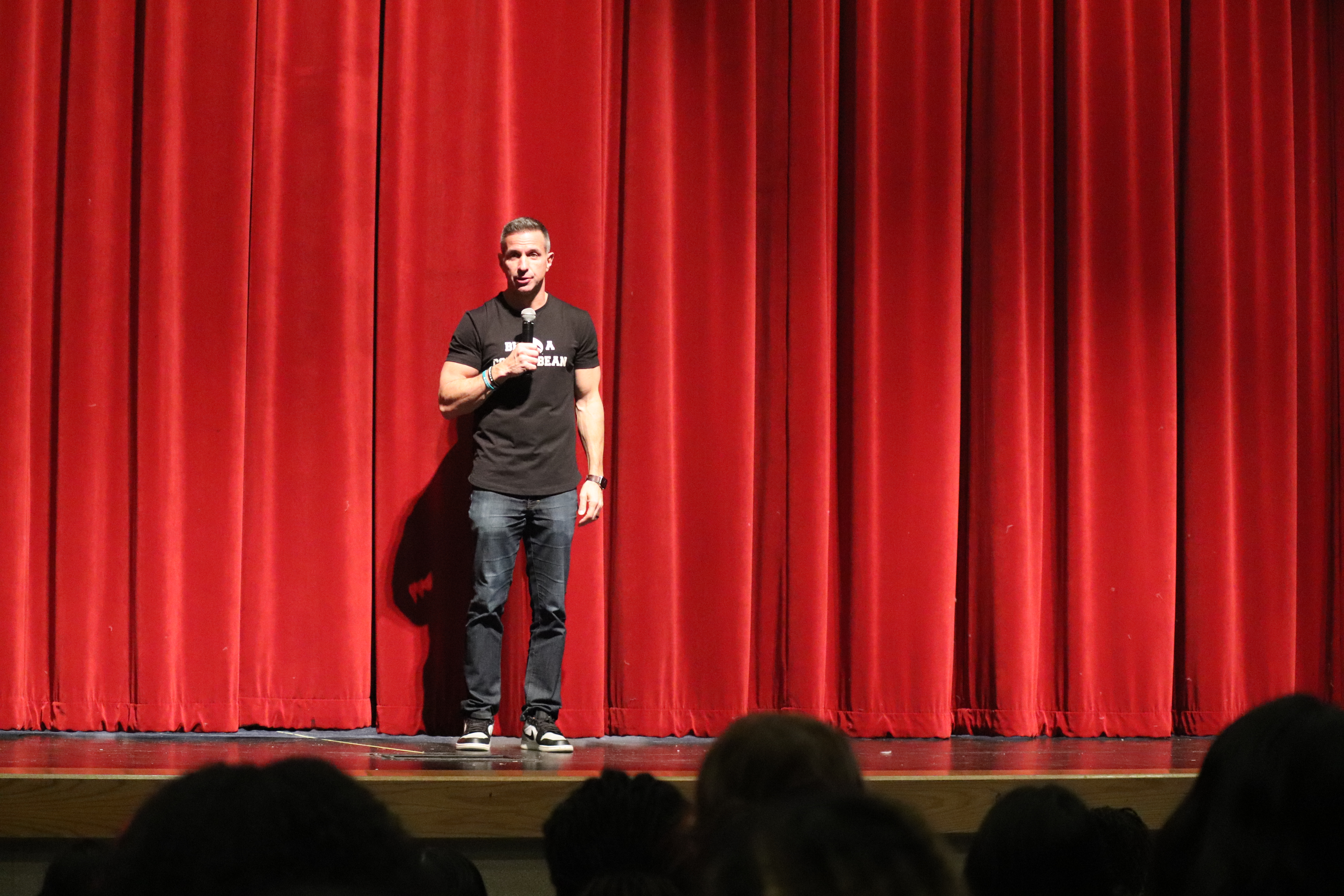
Port Arthur native, inspirational speaker and ex-convict Damon West told his story of battling addiction and being paroled after receiving the equivalent of a life sentence in prison to West Brook High School students Monday, Nov. 13.
“Whatever your circumstances are in life, no matter where you came from, or what you’ve done, there’s a chance you can become a better version of you,” West said during his opening remarks to the student body.
West said his story begins on July 30, 2008 in a little run-down apartment in Dallas.
“I’m sitting on this little ratty old couch, and sitting next to me on that couch is my meth dealer,” he said. “That got y’all’s attention!”
He described his transformation to best-selling author and college professor from a meth addict and leader of an organized crime ring 15 years ago.
Dallas Police had just arrested his partner-in-crime in a stolen car, and he knew his arrest was coming, he said.
While he was talking to his meth dealer, he said, his living room window shattered.
“I tried to get out of the living room as fast as I could, but it was too late,” he said. “Boom. The flashbang grenade went off in my face. Bright white light, loud noise blows me back on the couch.
And when I came to, when I could see and hear again, there’s this cop standing over me in full SWAT riot gear, his boot is on my chest, the barrel of an assault rifle is digging in my eye socket, and his finger is on the trigger.”
West remembers one of the SWAT officers saying, “We got him! We got the uptown burglar.”
“That’s a name I’ll live with for the rest of my life,” he said.
West said he now sees the day of his arrest as the day he was rescued.
“I got pulled out of a situation in life I couldn’t get myself out of,” he said. “In fact, in my story, the angels in my story don’t have wings. My angels have assault rifles. They have shields. They have helmets. They came through the window. They busted the door off the hinges to pull me out of that world that I was in. The Dallas SWAT team saved my life that day. That’s the shift in mindset. It took me a long time to understand that.”
West said he and about a dozen other meth addicts had broken into the homes of residents in the uptown neighborhood of Dallas to feed their addictions.
Although all of West’s crimes were property crimes, he said his was set at $1.4 million dollars when he was booked into the Dallas County Jail.
“No one was home during these burglaries,” West said. “I never saw my victims. They never saw me. No one was physically hurt. But Dallas county sent me a very clear signal with my bond.”
His trial date was set for May 18, 2009 and lasted for six days for RICO charges for organized crime. The judge ultimately sentenced him to serve 65 years in the Texas Department of Criminal Justice, which is the equivalent of a life sentence, he said.
“Now, obviously, I didn’t do the entire life sentence inside of a prison,” he said. “I did seven years and three months in that maximum security penitentiary a few miles from here called the Mark Styles Unit.”
“It’s one of the toughest prisons in Texas. It’s actually one of the toughest prisons in America.”
By the time of his parole in 2015, West said he had become a model inmate. He was working as a chapel clerk when the Chaplain came to tell him the parole board was summoning him.
“You had it all, Mr. West,” he said he remembers a woman in the parole board meeting telling him. “You had every advantage, every privilege, and every opportunity over everybody your entire life. She said, you are the definition of a privileged person in this country. And you know what? She was right.”
West said his mother was a schoolteacher and a nurse and his father was a well-known sportswriter who made history when he wrote a story about black athletes on the front page of the sports section in 1971 and received hate mail and vandalism for it.
But he said he remembers his father telling him, “Damon, I want you to see what it looks like to take a stand and do the right thing. Sometimes, it means you’re going to have to stand alone.”
West was a three-year starting quarterback at Thomas Jefferson High School and received a scholarship playing football at the University of North Texas in Division One college football, but an injury during a game against Texas A&M ended his career in 1996.
“When I got to that fork in the road in life, and football was gone, my identity was gone with it,” he said. “What I did is I made the mistake of wrapping my identity up into something external. When you tie your identity up to something like your car, the house you live in, the friends you hang out with, social media, you set yourself up for failure.
“And I failed, y’all. I got into hardcore drugs at this point. Cocaine, ecstasy, pills. But I graduated college. I was a very functional addict.”
After graduating college in 1999, West worked in the Capitol building in Washington D.C. and a branch of UBS bank in Dallas when a coworker caught him sleeping at work and offered him crystal meth as a pick-me-up.
“It was at that job in 2004 that my life and the lives of so many other innocent people would forever change,” he said. “I smoked that drug one time, and I was instantly hooked, just like that. And I gave everything away for that drug because that’s what addicts do. We give things away.
“I gave away my job, my home, my car, my savings account, my family, my tethering to God. In 18 months, I went from working on Wall Street to living on the streets of Dallas.”
West said he turned to breaking into cars, storage units and shoplifting but then feeding his addiction turned into home burglaries, which continued for three years until his arrest.
“When I broke into my victims’ homes, I didn’t just steal property from my victims,” he said. I stole something way more valuable for my victims, something my victims can never get back—that is their sense of security. I can’t replace that. I can’t fix it.”
During his parole hearing, West remembers the parole officer asking him about how he contributed to changing the atmosphere of the prison and she asked him for just one word for how he wanted his life to be remembered.
“Ma’am, I just want to be useful,” he said he told her. “Useful. That’s my word. Useful. And I could be useful inside this prison, or I could be useful out in the free world again.”
Although West is no longer in prison, he said his parole does not end until 2073—50 more years away.
But one story from a fellow inmate changed his experience in prison, he said, and his life.
“I’m a coffee bean,” West said several times during his speech.
The day that he was sentenced to life in prison, he met an older black man named Mohammed who told him prison is like a pot of boiling water. Boiling water turns carrots soft and eggs hard, but coffee beans change the water around them.
The challenge he said his new friend told him, was not to become sad and weak like the carrot, or hard and angry like the egg, but to keep a smile on your face and try to change the situation around you every day.
West said Mohammed warned him against joining any prison gangs and instead “earn the right to walk alone.”
This is the story that inspired his best-selling book released in 2019, The Coffee Bean: A Simple Lesson to Create Positive Change.
After being released on parole, West earned a master’s degree in criminal justice and now teaches college courses about prisons in America at The University of Houston.
For more information about West’s books and speaking events, visit damonwest.org.


 Eleanor Skelton